Grooming
Trust-building that slowly crosses into isolation, secrecy requests, boundary-testing, and sexual escalation — the classic arc used to exploit children and adolescents.
Protecting children, seniors, and vulnerable individuals from scams, grooming, sextortion, and digital manipulation with privacy-first AI that runs entirely on your device.
No cloud · No surveillance · Just protection.
Every day, millions of children, seniors, and vulnerable individuals face online grooming, financial fraud, romance scams, sextortion, and manipulation. Most of these threats start with what appears to be an ordinary conversation.
Agent Hita recognizes these categories of harmful behavior — each one representing a real pattern that puts people at risk. On Android it reads conversations on screen; on iPhone it checks the replies being typed, where these patterns show up as pressure, secrecy, and compliance.
Trust-building that slowly crosses into isolation, secrecy requests, boundary-testing, and sexual escalation — the classic arc used to exploit children and adolescents.
Threats to share intimate images unless the victim complies with demands. One of the fastest-growing and most psychologically devastating online threats.
Fabricated emotional relationships designed to build trust before extracting money — often targeting adults who are lonely, recently divorced, or grieving.
Urgent requests for gift cards, wire transfers, or cryptocurrency, often combined with artificial deadlines or emotional pressure to prevent the victim from thinking clearly.
Attempts to steal passwords, verification codes, or personal documents through social engineering rather than technical hacking.
Fake job, modeling, or money-making offers designed to get a person to meet in real life under false pretenses.
Repeated intimidation, blackmail, stalking-like persistence, and targeted distress campaigns intended to frighten or control.
On Android, Agent Hita notices when someone activates a mode that automatically deletes messages — a key warning sign that the contact wants to hide what they've been saying.
No parent should have to monitor every conversation their child has online. And no child would accept it. What families need is an early warning — not a surveillance feed.
Tools that read every message and upload conversations to the cloud damage trust, teach children nothing about safety, and create new risks of their own.
By the time something goes wrong, weeks or months of manipulation have already occurred. Early warning is the only warning that matters in digital exploitation.
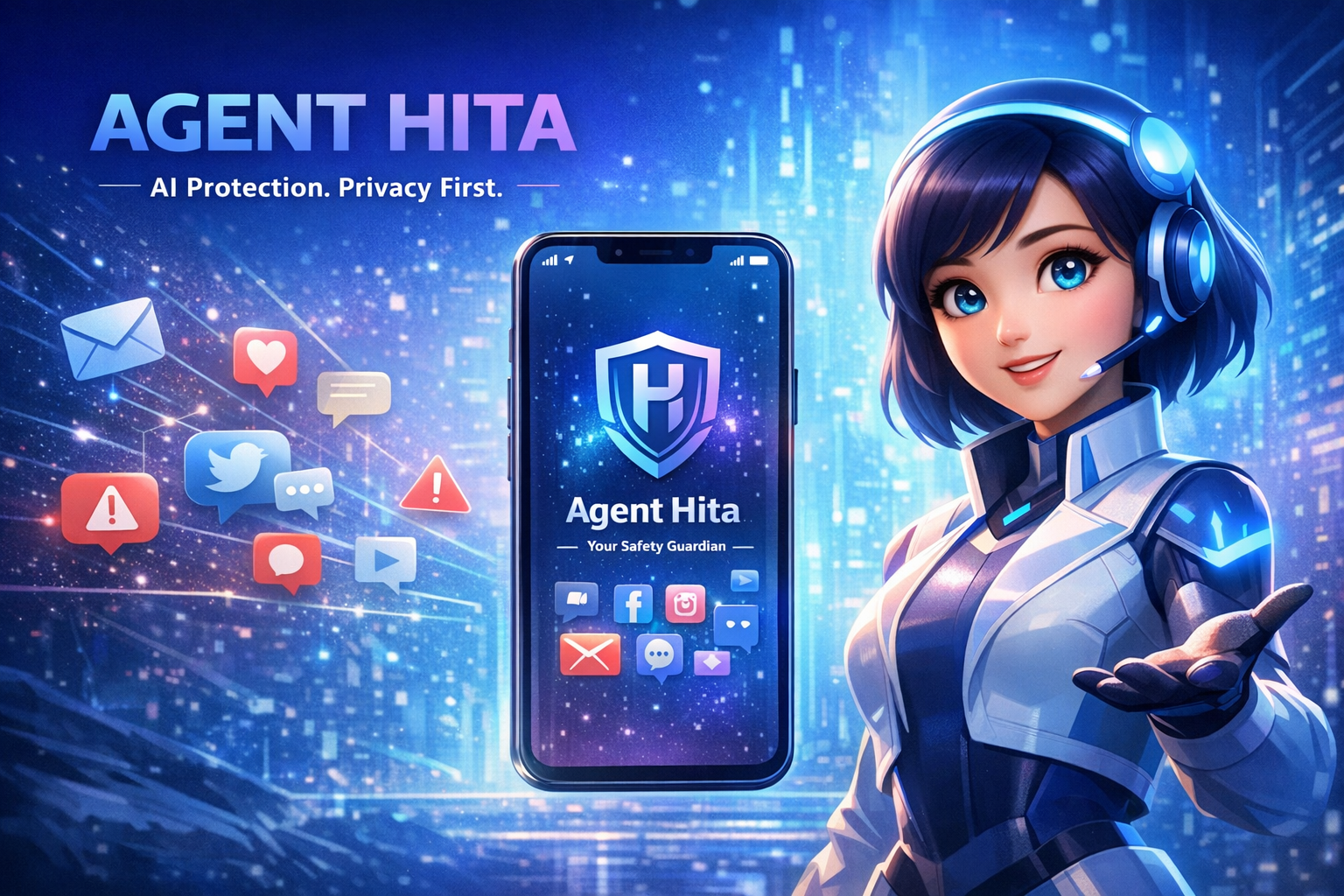
Agent Hita is a patent-pending app that detects harmful patterns in digital conversations — entirely on your device. It sees what a parent needs to see: not every word, but the warning signs that something is wrong. No messages leave the phone. No conversations are stored. Just an alert when something looks dangerous, and a trusted guardian who can act before harm occurs.
On Android, Agent Hita reads conversations on screen, on both sides. iPhone doesn't let one app see another, so on iPhone it works as a keyboard: as you or your child type in any app, it checks the reply — for example agreeing to keep a secret, handing over a code or password, agreeing to pay under pressure, or pleading with someone who is making threats — and warns when something looks unsafe. On iPhone, protection applies whenever the Agent Hita keyboard is the one being used.
No message content is ever stored or transmitted. Your conversations stay on your device — always.
Analysis runs locally on your phone — a compact AI model on Android, and Apple's built-in on-device AI on iPhones that support it, alongside a built-in rules engine. No cloud server required. No internet needed for analysis.
Works even on end-to-end encrypted apps like WhatsApp — because it works on your phone, not on a server. On Android it reads what's on screen; on iPhone it checks what's typed.
When risk is detected, a trusted guardian receives the risk category, severity, and when it happened — never actual message content. On iPhone, sending alerts uses the keyboard's “Allow Full Access” setting, which is used only for this — your typing is not sent to our servers.
Not just their devices.
Early release — available on Android and iPhone. We'd love your feedback.